Tuesday, December 11, 2012

Dry syrup Production

Dry syrup

A dry pharmaceutical syrup may be defined as a finely divided insoluble particle ranging from 0.5-5 μ, which is to be distributed in a suitable vehicle Dry syrups are the solid dosage form that can be reconstituted by the addition of water to administer by the oral route. Mostly antibiotics are available in dry syrup form. Besides, some moisture sensitive and pediatric drugs are also available in the form of dry syrup.

Production of Dry Syrup 
Mostly antibiotics are available in dry syrup form. Dry syrup at Renata is manufactured in three methods namely:
Ä  Direct Mixing,
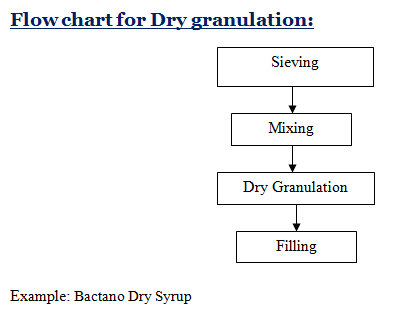
Ä  Dry Granulation (Slugging) and
Ä  Wet Granulation (wet massing).
The flow chart of the above mentioned methods are as follows.
Sealing & Checking
Packaging
Sieving

Blending
Filling
Labeling

Flow Chart of Direct Mixing
Flow chart for Wet granulation


Condition for manufacturing Dry Syrup:
Ä  Relative humidity: Not more than 60%.
Ä  Temperature: Below 250C
Ä  All relevant materials are removed
Ä  Equipment is cleaned
Ä  Balanced is calibrate
Ä  Bottle drying date
When these condition are fulfilled the area is ready for filling of dry syrup and sighed by :
@ Production officer
@ Checked by QA officer 
Machines used in Dry Syrup:
1.      Frewitt-Zimmer Mann Chimermann Granulator, Source: Germany.
2.      Karl-Kold Fluid Granulator, Source: Germany.
3.      Ciliotta Bottle Sealing Machine, Source: France.
4.      Macofar Automatic Bottle Filling and Sealing Machine, Source: Italy.
5.      Fitz mill (Sugar Crushing machine), Source: USA.
6.      Multimilling Machine, Source: Bangladesh
7.      Hutt Compactor, Source: Germany
8.      Roller Compactor, Source: India.
9.      Blender Machine (400 kg)
10.  Left Gun Bottle Filling Machine, Source: USA.


Saturday, December 8, 2012

Production of Capsule in Pharmaceutical Industry

Production of Capsule in Pharmaceutical Industry


Capsule
The word capsule is deriving from the Latin word capsulac meaning a small box. Capsule is the solid unit dosage form of medication with a separate body & cap (Both are gelatin shells). There are two types of capsules-Capsule with hard gelatin shell & Capsule with soft gelatin shell. Hard capsules are filled with powders & pellets, whereas soft capsules are filled with liquid or semisolid product.
 According to British Pharmacopoeia,” Capsules are the solid dosage form in which the drug is enclosed either in a hard or soft, soluble container or shell of a suitable form of gelatin”.
In this pharmaceutical industry filling (encapsulation), sealing and polishing (if required) of capsules of hard gelatin shell are done during manufacturing, as the industry does not manufacture any capsule shell.
 The active is filled in the empty the hard gelatin capsule shell in the form of-
Ø  Powder
Ø  Pellets
Powder and pellets are encapsulated using hard gelatin shell. Powders to be encapsulated are pre-compacted and do not need compaction. However, few powders need to be compacted to increase their flow properties. Different size of shell is used (0-3) but most abundance shell size used is size two, which are imported from India and some are locally made.

Source of EHGCS

1.      Global capsule Ltd. Bangladesh.
2.      Chemcaf capsule Ltd – India
3.      Associate capsule Ltd – India
After dispensing of essential from pharmacy according to FO the manufacturing process take place.


Machines used in encapsulation:
[  Sejong Encapsulation Machine
Source: Korea
Capacity: 60,000-65,000 cap/hour
[  p + am
Source: India
Capacity: 1, 20, 000 cap/ day
Parts of Encapsulation Machine
Ä  Shell portion contains- magazine
Æ  upper & lower segment/race way
Æ  pusher 
Æ  ejection filler
Ä  The powder portion contains- nozzles
Ä  Polisher portion contains- vacuum line & Brush
250 + 20 to 350 + 20 C
 
The environment control sheet capsule production room contains the following things:

ü  
Temperature level: 

ü  % RH
ü  Dry bulb temperature
ü  Wet bulb temperature
ü  Date
ü  Time
ü  Extreme condition of month-
Ä  Maximum
Ä  Minimum
ü  Remarks
This condition of the encapsulation room is inspected by production by officers and by the respective officers of QA department

Capsule Polishing
Not all but most capsules need polishing. Polishing is done first by machine (p + am) and then by hand. Towel polish is done with silicone emulsion which removes dust, adherent powder and gives a shiny appearance.
Problem associated during encapsulation:
Ä  Formulation of pin hole in the shell
Ä  Cap & body color variation
Ä  Brittleness of the shell
Ä  Logo imprintation


Friday, December 7, 2012

Product Development Department in Pharmaceutical Industry


Product Development Department

Many companies market have same drug products, but not all are identical in context to physical parameters which in turn affect the biological aspects like absorption and distribution of a drug. Quality of a drug product depends on quality of formulation. Product Development Department successfully does it all.

Functions of Product Development Department
Æ  Launching of a New product
Æ  Reformulation
Æ  Reprocess
Æ  Trouble shooting
Æ  Preparation of B.M.R. for a new product.
Æ  Development of existing product.

New Product launching:
For launching a new product, product development department follow the following steps-


The pre formulation study consists of:
1.      Raw material specification
2.      Product specification
3.      Pharmacological action
4.      Toxicology
5.      Formulation
6.      Manufacturing
7.      Market product study: if the product is new for our country or the product is exsting in the local market.
8.      Packaging.
9.      Stability testing
10.  Analysis

Development of existing product:
Existing products demand research in order to: 
Ä  Increasing the quality of the product.
Ä  Prevention of any type of problem existing in the product.
Ä  To save time and cost.
Increasing the patient acceptance
Reprocessing:
Reprocessing is done for finished product if it fails quality control test due to shortage of any excipient or active ingredient. In such case the finished product is crushed and shortage amount is mixed is processed and a new BMR is prepared.
Trouble shooting:
Product Development also solves various in process problem during a batch production.
Instruments available at PD core area
Granulation Room

Ä  PMS Fluid Bed Processor
Ä  GHL High Speed Mixer Granulator (SMG)
Ä  Drum Blender
Ä  Electrical Heater
Ä  PMS Granulator
Ä  Electronic Top Loading Balance
Ä  Super Mixer Grinder
Ä  Vibro-Sifter
Ä  Hot Melt Granulator

Compression Room
Ä  Cadmach(CM3B)
Ä  Hardness Tester
Ä  Hand Filling Capsule Machine
Ä  Mettler Tolledo E. Balance
Ä  Vacuum Cleaner


Coating Room
Ä  Magnetic Stirrer
Ä  BOSCH Stirrer
Ä  Thai Coater
Ä  Coating Machine (Kevin)
Wurster Room
Æ  Wurster Coater

Core Area
Ä  Hot Air Oven
Ä  Hot Air Sterilizer
Ä  High Shear Laboratory Mixer (Silverson)
Ä  Adventurer Electronic Balance
LCO
Æ  Laminar Air Flow Hood
Washing and Sterilizing Area
Æ  Water Distillation Machine
Sterile Filling Area
Ä  Laboratory Autoclave
Ä  Laminar Flow Unit
Ä  Check Station

Steps of Product Development Personnel To Launching A New Product:
Phase: 01 - Information
[  NFD & Pre-NFD information
Ä  Fill-up a pre-NFD form
Ä  Approval by engineering, production & QC department
Ä  Approval of NFD
Ä  Send approval NFD to PMD & QC
Ä  Mention if there are any other special criteria
Phase: 02 – Research
[  Literature Search & Project Planning
Ä  Book Research
Ä  Internet search
Ä  Innovators Web search
Ä  PD Project Planning
Ä  Product Development Requisition
[  Material Sourcing
Ä  Sourcing of active Raw material
Ä  Potential Supplier List
Ä  Sample for analytical development
Ä  Reference sample collection.
Ä  API analytical report.
Ä  Excipients testing (Special Items only) report
[  Active Purchasing/ Collection for PD
Ä  Sourcing of active Raw material
Ä  Potential Supplier List
Ä  Support of OSD 
[  Active Testing & Method validation
Ä  Method Validation for Active
Ä  Method validation for Finished Products


[  Pre-formulation studies
Ä   Major Pre-formulation parameters of API
Ä   Brand Products Formulation/Excipient Selection
Ä   Binary Incompatibility study report
Ä   Critical Pre-formulation research
[  Innovator’s/Brand Product Purchasing
Ä   Physician Desk Reference
Ä   Out sourcing 
[  Innovator’s/Brand leaders Product Testing
Ä  Physico-chemical Testing
Ä  Primary Packaging component report
[  Primary Packaging Material selection
Ä   Incompatibility analysis with primary packaging.
Ä  Analysis of Product Critical Factors
Ä  Analysis of Process critical factors
Ä  Prototype formulation
Ä  Manufacturing flow chart
[  Product Brief and Specifications
Ä  Drug information Search
Ä  Brand and pilot batch Analysis Report
Ä  Prototype formulation
Ä  BMR of new product

Phase: 03 – Formulation
[  Lab batch & Stability Batch Preparation
Ä  Preparation of Laboratory Batch
Ä  Packaging of Laboratory Batch.
[  Analytical Evaluation of Finished Products
Ä  Chemical Analysis
Ä  Physical Analysis
Phase: 04 – Stability Study
[  Stability Study
Ä  Stability study report-1 Month
Ä  Stability study report-3 Month
Ä  Stability study report-6 Month
Review and Specification Approval
 Phase: 05 – Scalae-Up and Production
[  1st Scale-up Batch Production
Ä  Analysis of 1st Scale-up Batch
[  2nd Scale-up Batch Production
Ä  Analysis of 2nd Scale-up Batch
[  3rd Scale-up Batch Production
Ä   Analysis of 3rd Scale-up Batch

[  Process Validation & Reporting
Ä  Process Qualification
Ä  Production Facilities
Ä  Production & Packaging environment
Ä  Batch Documentation