Tablet
Tablet
is the most used dosage form in the world. Because of –
I.
High stability
II.
Easy to transport
III.
Least expensive
IV.
Large scale production
V.
Product indication is very simple
VI.
Control release of drug
VII.
Reliable therapy
VIII.
Conventional route for administration
Tablets
are the solid preparations each containing a single dose of one or more active
ingredients and obtained by compressing uniform volume of particles.
According
to British Pharmacopoeia, “Tablets are solid dosage forms circular in shape
with either flat or convex faces and prepared by the compression or compaction
of suitably prepared medicament by means the tablet machine”.
Tablets
are intended for oral administration. Some are swallowed whole, some after
being chewed; some are dissolved or dispersed in water before being
administered and some are retained in the mouth where the active ingredient is
liberated.
Being
the most common, convenient and inexpensive dosage form, tablet formulation and
design is the most important consideration in solid dosage form production in
the pharmaceuticals, which may be described as the process whereby the
formulator ensures that the correct amount of drug in the right form is
delivered at or over the proper time at the proper rate and in the desired
location, while having its chemical integrity protected to that point.
In
tablet manufacturing, facilities for dry granulation, wet granulation and
direct compression are available. For all solid and semisolid section all the
ingredients are dispensed centrally by “Pharmacy” against FO. Penicillin
tablets are manufactured using dry granulation using separate facilities. Most
of the tablets are done using wet granulation and fewer by direct compression.
In
tablet manufacturing, facilities for dry granulation, wet granulation and
direct compression are available. For all solid and semisolid section all the
ingredients are dispensed centrally by “Pharmacy” against FO. Penicillin
tablets are manufactured using dry granulation using separate facilities. Most
of the tablets are done using wet granulation and fewer by direct compression.
Unit
of tablet section:
Ä Dispensing
Unit
Ä Granulation
Unit
Ä Compression
Unit
Ä Coating
Unit
Wet granulation
Wet
granulation is widely used technique. Dry granulation is used for the
preparation of antibiotic table.
Flow chart for Wet Granulation

Preparation of Starch Paste:
1. Distilled water is added to make a suspension.
2. Boil distill water by passing steam in a separate
container (1000C).
3. Add the hot water to the suspension and is stirred
vigorously.
4. The paste is allowed to cool down to 400C
and is applied to the mix.
Flow chart for Dry Granulation

Flow chart for Direct Compression:


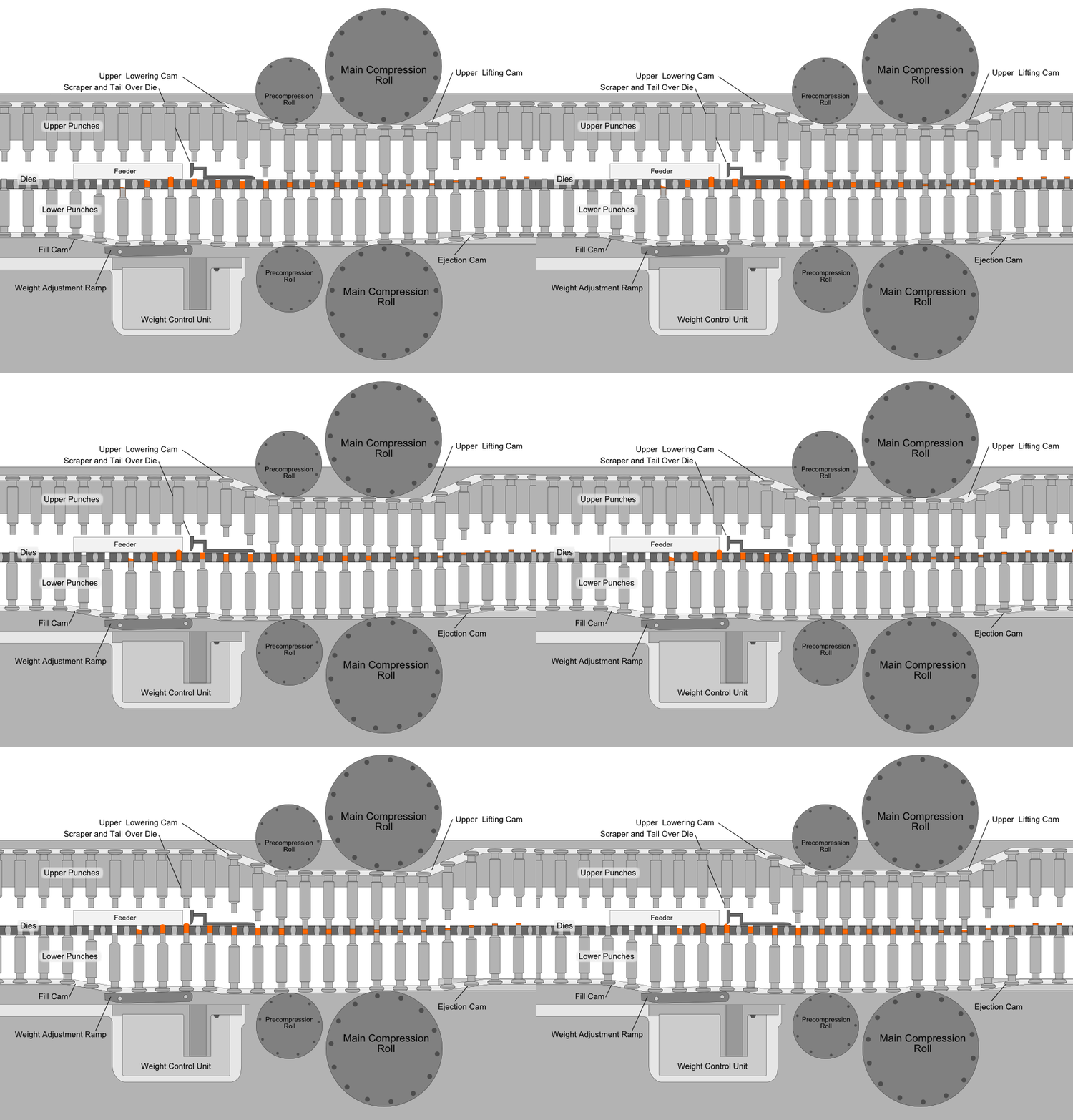

Fig:
Tablet manufacturing procedure
A formulation order
consists of the following things
1.
Product name
2.
Product description
3.
Product code
4.
Lot number
5.
FO number
6.
FO effective date
7.
Cost centre
8.
Pharmacy weighting & date
9.
Pharmacy certification
10.
Component grade
11.
Batch in Grams
a) Standard
b) Dispensing
12.
Actual potency
13.
Actual batch activity in GMs
14.
Validation up to
This FO prepared &
checked by PD; Approved by-
ü Q.A.
Manager
ü Production
Manager
ü Plant
Manager
